My Advice · 22 November 2026 · 5 min read
TM30 and the 90-Day Report in Pattaya: What You Actually Have to Do
 By Shane Ruddle
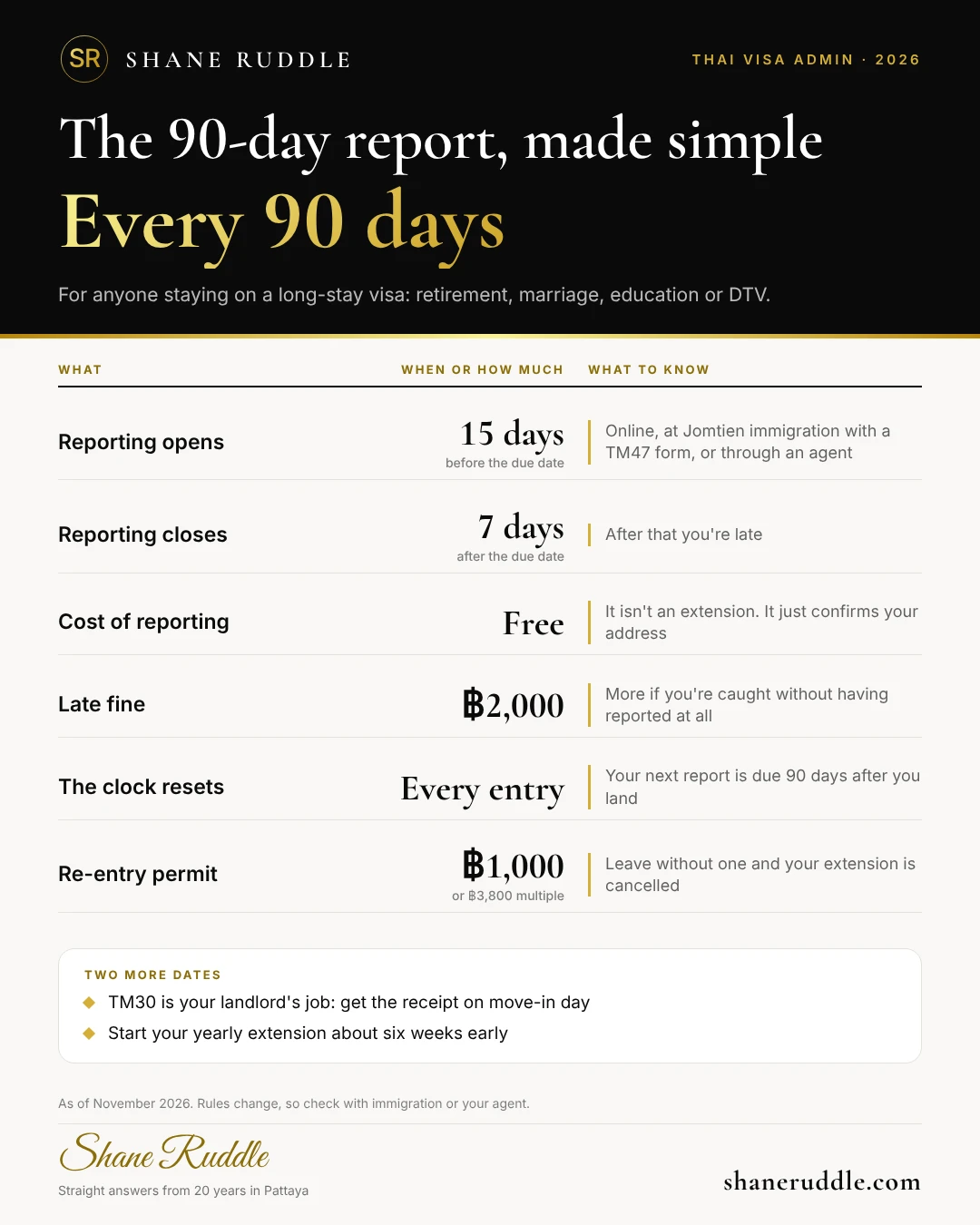
Thai visa admin · 2026
The 90-day report, made simpleEvery 90 days
For anyone staying on a long-stay visa: retirement, marriage, education or DTV.
| What | When or how much | |
|---|---|---|
| Reporting opensOnline, at Jomtien immigration with a TM47 form, or through an agent | 15 daysbefore the due date | Online, at Jomtien immigration with a TM47 form, or through an agent |
| Reporting closesAfter that you're late | 7 daysafter the due date | After that you're late |
| Cost of reportingIt isn't an extension. It just confirms your address | Free | It isn't an extension. It just confirms your address |
| Late fineMore if you're caught without having reported at all | ฿2,000 | More if you're caught without having reported at all |
| The clock resetsYour next report is due 90 days after you land | Every entry | Your next report is due 90 days after you land |
| Re-entry permitLeave without one and your extension is cancelled | ฿1,000or ฿3,800 multiple | Leave without one and your extension is cancelled |
Two more dates
- TM30 is your landlord's job: get the receipt on move-in day
- Start your yearly extension about six weeks early
As of November 2026. Rules change, so check with immigration or your agent.
If you live in Thailand on a long-stay visa, two bits of paperwork follow you around: the TM30, which tells immigration where you're staying, and the 90-day report, which confirms you're still at that address every 90 days. The TM30 is mostly your landlord's job. The 90-day report is yours, and you can usually do it online. Neither is difficult once you know the rhythm, but both catch out newcomers in their first year.
I've lived in Pattaya for over 20 years, and these are the two things I see people forget most. Here's how they work, as of November 2026.
What is a TM30?
A TM30 is a notification to immigration that a foreigner is staying at an address. Legally, the duty sits with the owner or the person in charge of the property: the hotel, the landlord, or the condo office. Hotels do it automatically. If you rent a condo or a house, the landlord or the building's juristic office should file it when you move in.
Where it matters to you is later. When you apply for a visa extension at the immigration office in Jomtien, you're often asked for proof that a TM30 was filed for your current address. If it wasn't, the extension can stall while it's sorted out.
So when you sign a lease, ask the landlord or agent to file the TM30 and give you a copy of the receipt. Keep it with your passport papers. If you own your condo, you're the owner and the person staying, so you file it yourself, or your agent does.
Do you need a new TM30 after travelling?
Rules on this have changed over the years, and offices haven't always applied them the same way. Many landlords re-file when a tenant comes back from abroad to be safe. It's a two-minute job for them, so ask. If you're unsure what your extension will need, your visa agent will know what Jomtien is asking for at the moment.
What is the 90-day report?
If you stay in Thailand for 90 days in a row on a long-stay visa, such as a retirement, marriage, education or DTV stay, you have to report your address to immigration every 90 days. It isn't an extension and it costs nothing. It simply confirms you're still where you said you were.
The count restarts every time you enter the country. If you leave for a holiday and come back, your next report is due 90 days after you land, not 90 days after your last report.
How do you do the 90-day report?
You have three ways to do it:
- Online, through the immigration bureau's 90-day reporting site. This is what most people I know use now. It works best once you've done at least one report in person at that address.
- In person at the immigration office in Jomtien. Bring your passport, your last 90-day receipt if you have one, and a completed TM47 form. Go early.
- Through an agent, who will take your passport copy and do it for you for a small fee.
You can report from 15 days before the due date until 7 days after it. Whichever way you do it, keep the receipt with your passport, because it shows your next due date.
What happens if you forget?
You'll be fined. The fine for reporting late is ฿2,000, and it's higher if you're caught without having reported at all. It won't usually cost you your visa, but it's an avoidable expense and an avoidable morning at immigration.
The easiest fix is a calendar reminder. Use the calendar below: put in the date you last arrived or last reported and it gives you your next four due dates, with reminders, plus your extension window if you add the date your permission to stay ends.
The other dates to keep an eye on
The 90-day report is the one that comes round most often, but there are two others that matter more:
- Your yearly extension. On a retirement or marriage visa you renew at Jomtien once a year. Start the paperwork about six weeks before, especially if you need money sitting in a Thai bank for a set time first. The retirement visa guide has the money rules.
- Re-entry permits. If you leave Thailand without a re-entry permit, your extension is cancelled. It's ฿1,000 for a single re-entry or ฿3,800 for multiple. Get it before you go to the airport.
What I'd tell a friend
Use an agent for your first year. There are plenty around the city, and they make the whole experience a lot less painful. Once you've seen how it works, the 90-day report is easy to do online yourself.
Ask your landlord for the TM30 receipt on the day you move in, not the week before your extension. Put every date in your phone. And never leave the country on an extension without a re-entry permit.
For more on settling in, read your first month in Pattaya and visas in Pattaya. Rules change often, so treat this as a guide and check with immigration or your agent. For more practical notes, join my newsletter.